


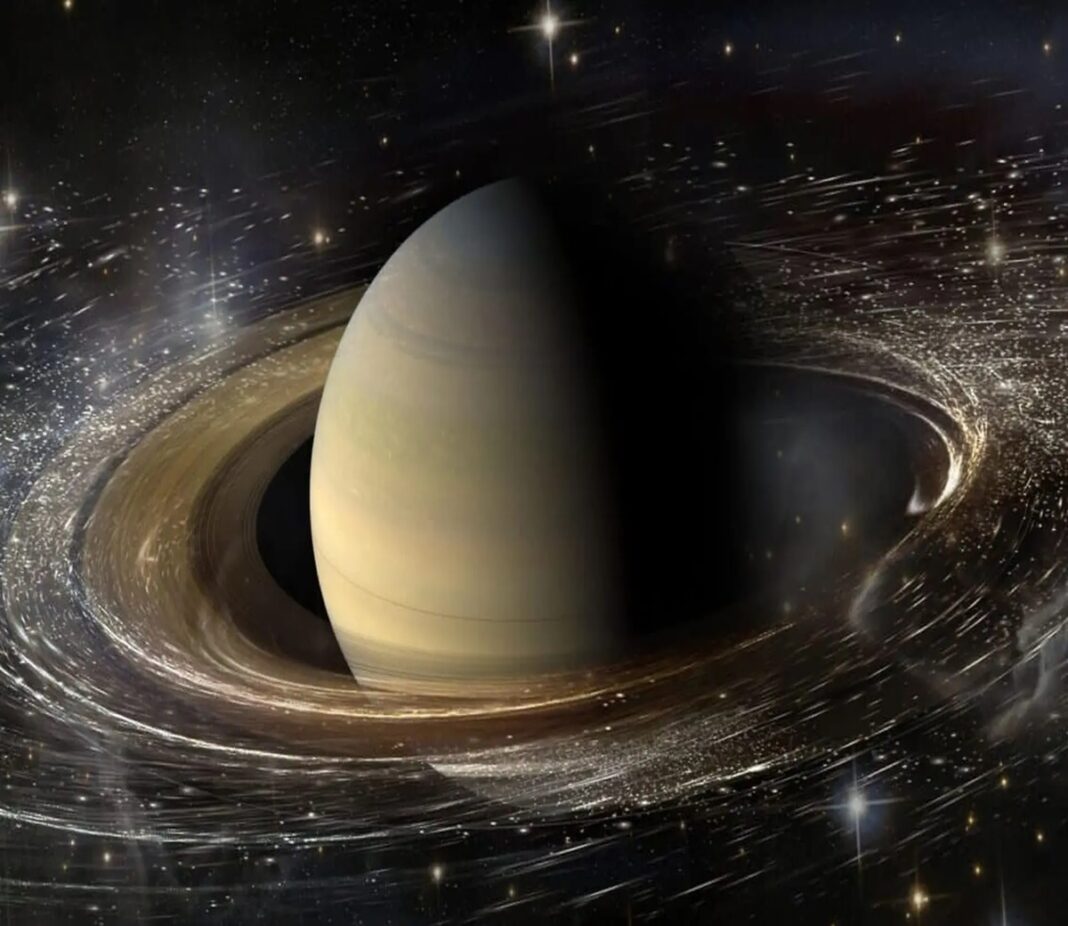
Astronomers analyzing recent high-resolution planetary images from NASA have uncovered an unexpected atmospheric phenomenon shaping the cloud decks of the solar system’s second-largest gas giant. New observations confirm that the Saturn south pole decagon wave represents the first regular, multi-sided jet stream pattern ever documented in the planet’s southern hemisphere.
The newly spotted decagon is a giant atmospheric wave embedded directly inside a fast-moving southern jet stream centered around 63 degrees south latitude. Multi-wavelength observations captured by the Hubble Space Telescope demonstrate that the structure extends vertically across multiple altitude layers rather than existing as a shallow surface feature. Individual sides of the decagonal wave stretch across thousands of miles, forming a distinct geometric outline around the dark polar region.
How Do NASA’s Decagon and Saturn’s Hexagon Differ?
While Saturn’s northern hexagon has remained a permanent, stable atmospheric feature for over four decades, the southern decagon appears to be a newly emerging, dynamic phenomenon. Data gathered through NASA’s Outer Planet Atmospheres Legacy program shows that the southern wave began forming around 2023 and has steadily strengthened over subsequent observation cycles.
Watching a massive planetary wave develop in real time allows astrophysicists to test complex atmospheric models against direct observational data. Researchers plan to combine future Hubble and James Webb Space Telescope observations to evaluate how long the decagon will persist and identify the thermal energy sources driving its growth.
The discovery opens exciting research avenues regarding gas giant atmospheric behaviors. Continued tracking will clarify whether the decagonal wave stabilizes into a permanent polar feature or dissolves as seasonal sunlight shifts across Saturn’s southern hemisphere.
