


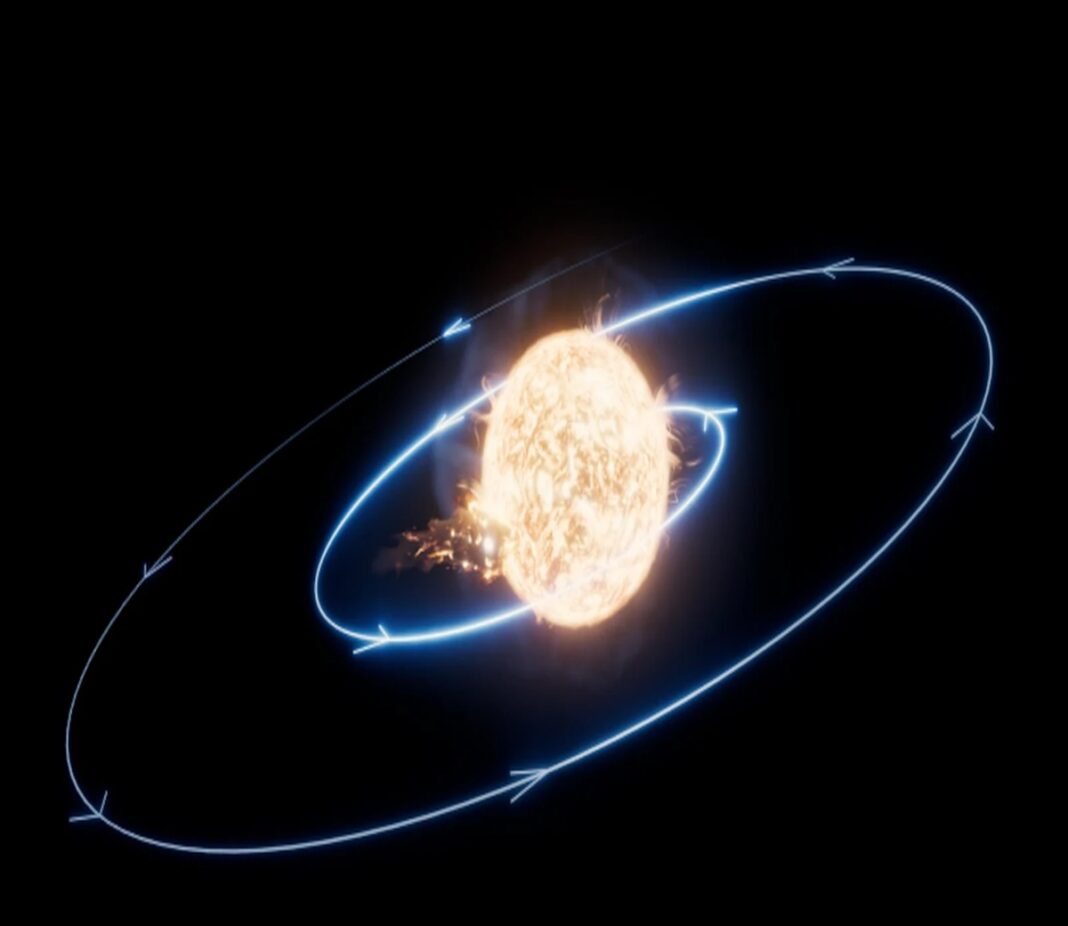
New astrophysical research led by scientists at Ege University suggests that the early Sun swallowed a super-Earth planet billions of years ago. During the formation of the solar system, a massive rocky world ranging between five and ten times the mass of Earth likely migrated inward through the dense protoplanetary disk of gas and dust before eventually falling directly into the infant star.
Incorporating planetary engulfment into stellar evolution models helps resolve persistent differences between physical observations of the Sun and theoretical models. Specifically, the heavy elements contributed by the engulfed planet alter internal solar density, sound-speed measurements, and the precise depth of the convection zone. Furthermore, this planetary consumption offers a plausible chemical mechanism explaining why the Sun’s surface exhibits an unusually low abundance of lithium compared to initial solar formation estimates.
Does The Sun Still Hold Remnants Of A Lost World?
Computer simulations demonstrate that a compact super-Earth could withstand initial aerodynamic heating, plunging deep into the Sun before fully dissolving. Because planets possess chemical compositions distinct from surrounding interstellar gas, the consumed heavy material left an enduring chemical fingerprint beneath the Sun’s outer layers. These chemical and structural signatures have persisted for over four billion years, offering astrophysicists a detectable record of early planetary engulfment.
While current conclusions rely on advanced computer modeling and helioseismic data, astronomers are designing high-precision spectroscopic and seismic observations to detect independent chemical signatures inside the Sun. Validating these internal solar fingerprints will confirm the fate of our solar system’s lost inner world while improving overall scientific understanding of planetary system evolution.
