


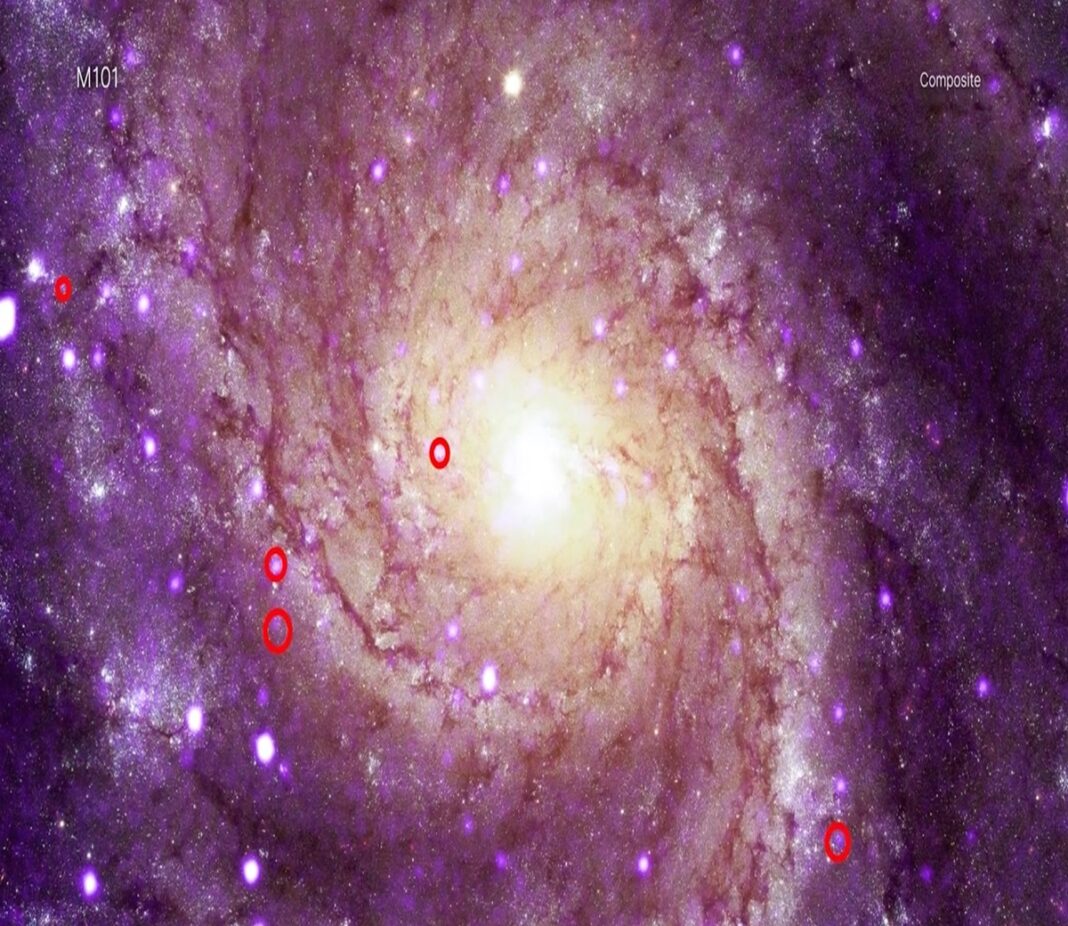
Scientists have identified a new class of cosmic objects emitting intense ultraviolet radiation across nearby galactic structures. Astrophysicists analyzing archival astronomical data uncovered the phenomenon, which could reshape understanding of high-energy stellar systems and help resolve long-standing observational gaps in deep-space research.
A research team led by University of Alabama astrophysicist Mustafa Muhibullah mined publicly available data from NASA’s Chandra X-ray Observatory. Scientists identified eighty-four distinct objects across six target galaxies, including the Andromeda spiral galaxy M31 and the Pinwheel spiral galaxy M101. The objects appeared distinctly in Chandra images taken at the absolute lowest X-ray energy thresholds, below 0.3 kiloelectronvolts, yet vanished at higher energy bands. Because low-energy X-rays directly border extreme ultraviolet light on the electromagnetic spectrum, researchers concluded these objects produce immense ultraviolet energy output.
How Do Scientists Think Hypersoft Cosmic Objects Form?
Scientists believe these hypersoft cosmic objects could be compact binary star systems. A black hole, neutron star or white dwarf may gravitationally pull material from a companion star. As the stellar gas falls inward, intense friction heats it to extreme temperatures, producing low-energy X-rays and large amounts of ionizing ultraviolet radiation before reaching the compact object.
Interstellar hydrogen and helium gas readily absorb extreme ultraviolet radiation, creating dense optical barriers for space telescopes near Earth. Discovering energetic hypersoft sources offers crucial clues regarding galaxy evolution and binary star lifecycles. Continued spectral mapping will help astronomers refine models of cosmic radiation and star formation mechanics.
