


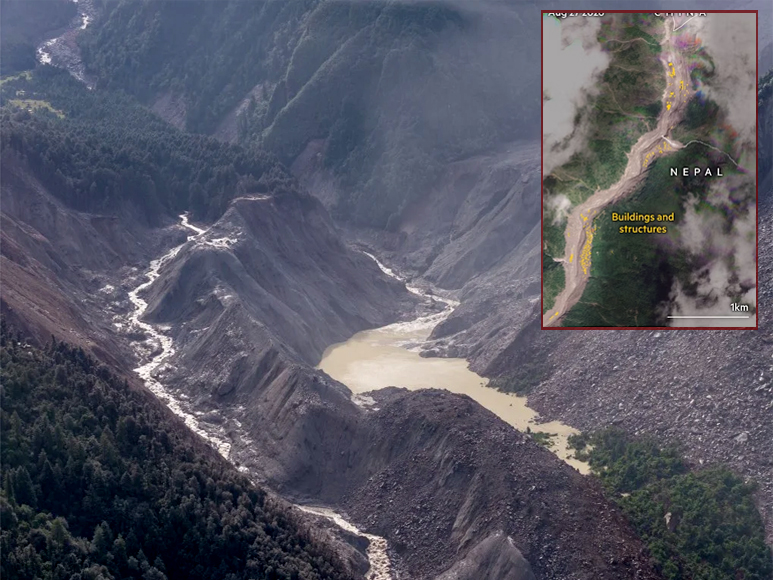
China issued an urgent flood warning to Nepal following the formation of a massive, unstable barrier lake along the Tibet-Nepal border. Glacial collapse debris dammed the confluence of the Chochen and Purepu rivers, impounding 2.5 million cubic meters of water. Chinese hydrologists alerted Nepalese officials that the reservoir water is rapidly darkening—a key indicator of incoming upstream debris and impending natural dam collapse—urging emergency evacuations downstream along the Lende Khola and Trishuli river corridors.
A severe high-altitude ice-rock avalanche and glacial collapse triggered heavy landslides near the Nepal-Tibet border. The resulting mud, ice, and rock debris choked narrow river channels near the confluence of China’s Chochen River and Nepal’s Purepu River, forming a massive natural dam. Satellite and drone surveillance confirmed that approximately 2.5 million cubic meters of water pooled behind the temporary obstruction, creating a high-risk barrier lake.
More Danger for Nepal:
Chinese water resource officials notified the Nepal Ministry of Foreign Affairs that satellite images show the impounded water rapidly changing to a dark, muddy hue. Hydrologists explain that a sudden shift in water color signifies heavy upper-slope erosion, soil displacement, and increasing sediment influx. This indicates that structural degradation of the natural debris dam is occurring rapidly, signaling a potential breach that could send a sudden flood wave downstream.
Also Read: IMD Issues Heavy Rain Alert For AP and Telangana
China’s flood modeling simulations indicate that a partial or full breach of the barrier dam could generate peak discharge rates of up to 500 cubic meters per second. While initial spillovers began flowing into the Lende Khola, Bhote Koshi, and Trishuli rivers at manageable levels, officials warned that a sudden collapse poses a severe threat to low-lying communities downstream. Authorities in Nepal have placed emergency disaster units on high alert and restricted highway access along vulnerable riverbanks.
