


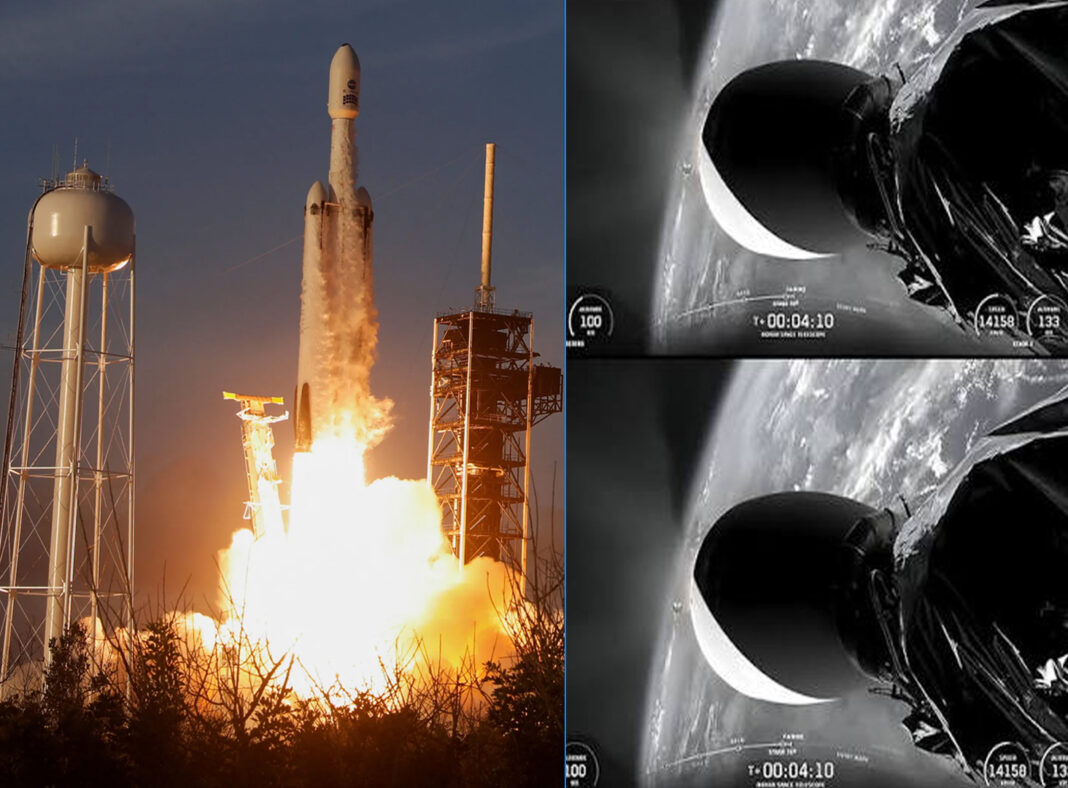
NASA successfully launched its Nancy Grace Roman Space Telescope aboard a SpaceX Falcon Heavy rocket from Kennedy Space Center in Florida. Heading toward the Sun-Earth Lagrange Point 2 (L2) about one million miles away, the observatory will reach its orbit in three months. Featuring a field of view 100 times larger than Hubble, the Roman Space Telescope will map billions of galaxies to study dark energy, dark matter, and discover exoplanets using gravitational microlensing.
The Nancy Grace Roman Space Telescope launched aboard a SpaceX Falcon Heavy rocket from Kennedy Space Center, heading to its operational orbit at the Sun-Earth Lagrange Point 2 (L2) located one million miles from Earth. Equipped with a panoramic field of view 100 times greater than the Hubble Space Telescope while matching its image clarity, Roman will map billions of galaxies in 3D. The mission uses wide-field surveys and gravitational microlensing techniques to measure the accelerated expansion of the universe driven by dark energy, map dark matter distributions, and discover thousands of distant exoplanets.
While maintaining Hubble’s optical sharp resolution, Roman captures giant cosmic swathes in a single frame, allowing astronomers to conduct deep space surveys hundreds of times faster. Its primary Instrument, the Wide-Field Instrument (WFI), measures light across visible and near-infrared wavelengths to track distant supernovae, galaxy clusters, and weak gravitational lensing. This broad coverage provides scientists with large-scale statistical data required to untangle the mysterious properties of dark energy—which makes up roughly 68 percent of the cosmos—and map the overall structure of the universe over cosmic time.
Following its launch, the spacecraft will undergo a three-month transit phase to reach the Sun-Earth L2 orbit, a gravitationally stable location ideal for uninterrupted astronomical observations. Once in place, engineers will complete instrument calibration, solar shield deployment, and system checks before commencing its five-year primary science mission. Data collected by the Roman Space Telescope will provide groundbreaking insights into star formation, planetary system evolution, and fundamental questions surrounding dark matter.
