


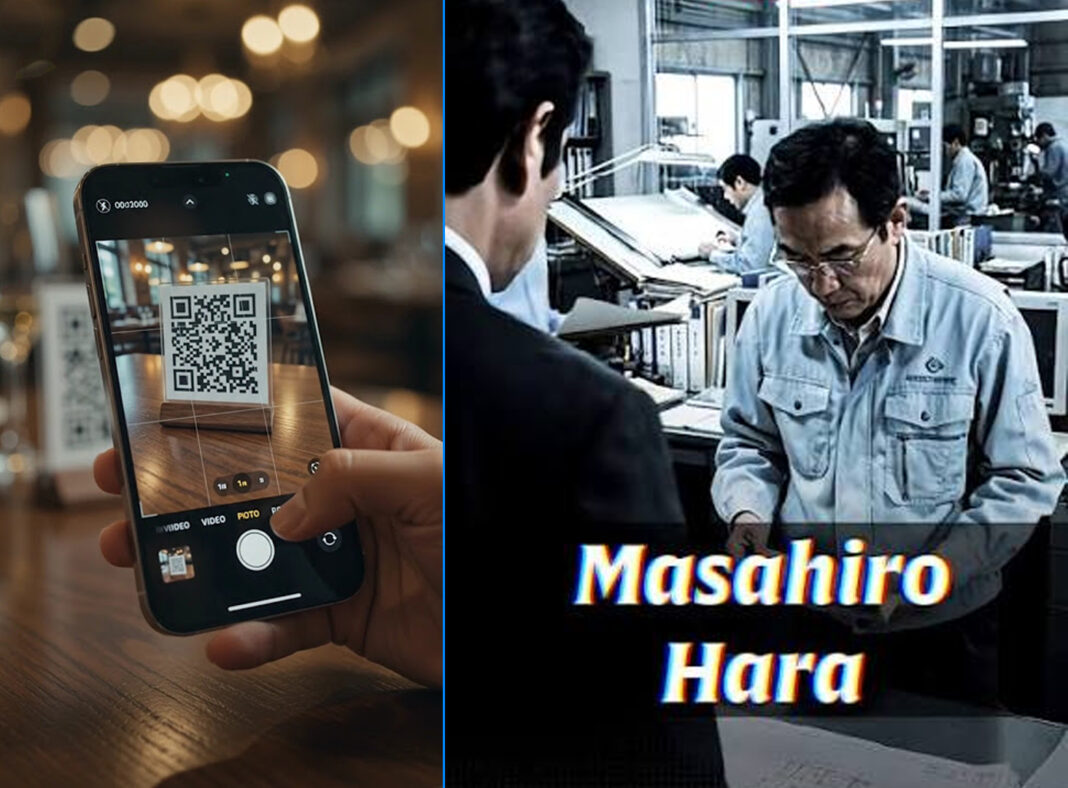
Invented in 1994 by Masahiro Hara, the Quick Response (QR) code relies on 2D binary modules (0s and 1s) to instantly transfer data. When scanned, position detection patterns locate the code while Reed-Solomon error-correction algorithms restore data even if up to 30% of the code is damaged. The phone decodes the merchant’s Virtual Payment Address (VPA), transmitting encrypted signals through the NPCI UPI network to complete instantaneous bank transfers.
A Quick Response (QR) code is a two-dimensional matrix barcode invented by Japanese engineer Masahiro Hara in 1994 to track automotive parts. Unlike standard 1D barcodes that encode data horizontally, a QR code stores binary information (0s and 1s) across a grid of black-and-white modules ranging from 21×21 to 177×177 cells. Three large square patterns located at the corners—known as finder patterns—allow smartphones to identify, orient, and decode the matrix from any scanning angle, while an outer clear space called the quiet zone isolates the pattern from visual noise.
How QR Code Works:
When a smartphone camera scans a QR code, the payment application immediately decodes the binary matrix into a merchant’s Virtual Payment Address (VPA). The application encrypts this payment request and sends it through the National Payments Corporation of India (NPCI) UPI architecture. Once the user validates the transaction by entering their secret passcode, centralized banking authentication servers verify the request and complete the fund transfer directly between bank accounts within seconds.
A critical feature of QR technology is the Reed-Solomon error-correction algorithm built directly into the module layout. This mathematical system creates redundant data blocks within the grid, allowing scanners to completely reconstruct lost or obscured information even if the physical QR code is scratched, dirty, or torn by up to 30 percent. Combined with end-to-end cyber encryption, these algorithms ensure millions of daily financial transactions remain fast, reliable, and secure.
